Primavera
The Northern Hemisphere officially left winter behind and entered a new season with the spring equinox on March 20th. This phenomenon, which occurs when the sun is positioned directly over Earth’s equator, derives its name from the Latin terms ‘aequus’, meaning equal, and ‘nox’, or night. At this point in the year, the darkness of winter fades and night and day become nearly equal in time.
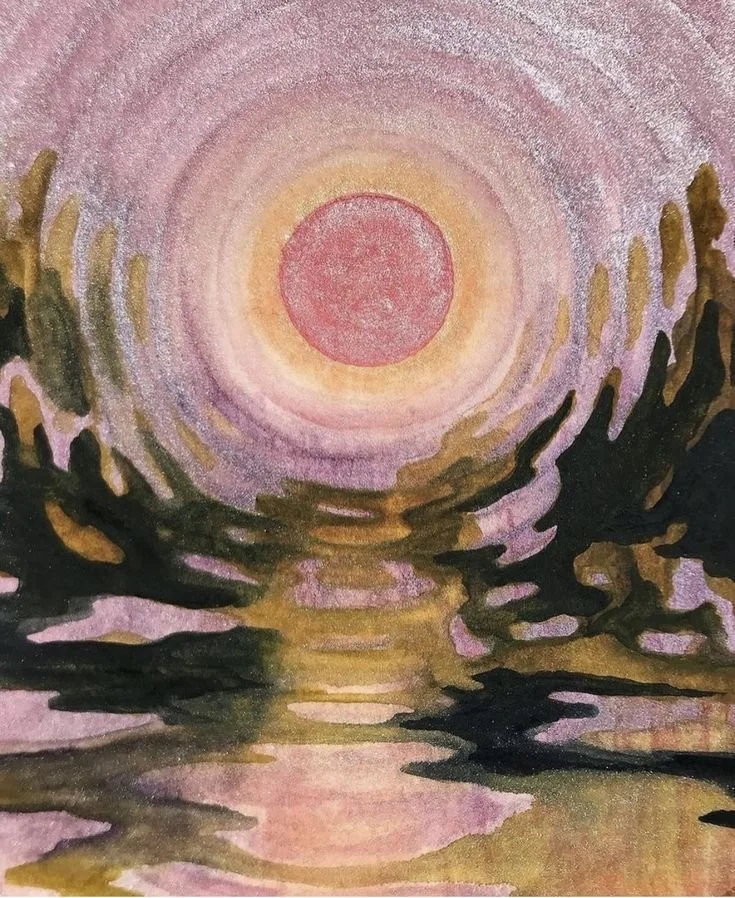
Painting by Renato Órdenes San Martín
I’ve never really followed the equinoxes or start of the seasons that closely. In Texas the seasons tend to blend together, so it’s slightly futile. It’s not rare to see spring or summer in winter. This past week though had me thinking about the start of this new season in a more deliberate manner as a dynamic I had been involved in since I graduated college ended around the same time. I found myself thinking about the calendar and it’s seasons in a way usually reserved for annual birthday and new years reflections.
I’d been saying and hoping that with each symbolic marker of time, I’d finally gain the courage or whatever to stop what it was that I was doing, the hurtful pattern I was engaging in, but I didn’t- and I did try and almost succeed a few times. What made it more frustrating was that knew what was going on, I knew that it wasn't about this person, but the wounds they were mirroring back to me, and yet I always ended up reengaging. I felt like a more aware version of Carrie in seasons one and two of Sex and the City. Not a proud place to be in.
But I see now that it was never the right time before because there was more I needed to learn, more I needed to say. I was being handed an opportunity to do things differently, to speak and assert myself when I had always wanted to run or freeze. And while I didn’t do it perfectly, it ended after I was honest with this person about my experience instead of pretending. The ending came with the beginning of spring.
This season, the season of rebirth, growth, and transformation, has been celebrated by various cultures throughout history and continues to have a lasting influence. Today, the spring equinox is associated with Holi celebrations in India and Nepal, Nowruz in Persia, and the timing of Lent and Easter in Christian societies. Even with changing beliefs, religions, and empires, the season of spring was a time of celebration and deep symbolism because the physical manifestation of the changing season could be felt.
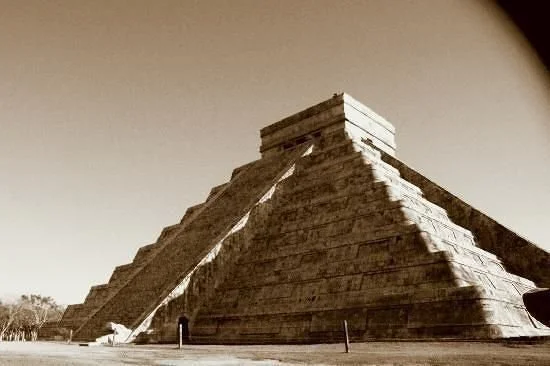
Every year, people gather at Chichén Itzá in Mexico to celebrate the spring equinox
It’s easy to dismiss this impact of seasons in modern society, but for most of history, civilization was agricultural based and each season had a significant effect on daily life. Seasons literally increased or decreased your chance of survival. The coming of spring meant a reprieve from the death of winter, a time of fertility, blooming plants, budding life, and the planting of new seeds supported by longer days and ripening conditions.
So even as some us may not be affected by the physical seasons so much, spring continues to symbolize a time of rebirth and rejuvenation. Hibernating animals crawl out of their caves. The flowers bloom. Cycles end and begin.
This contemplation of spring and its symbolism this last week reminded me of one of my favorite Renaissance paintings hanging in the Uffizi Galleries in Florence.
I was lucky enough to see it a few summers ago when I visited Italy, but the first time I saw the painting was in my 10th grade English literature class. If I’m recalling correctly, I remember it hanging on the wall opposite of a print of the Lady of Shallot. I’d look over at this poster print after writing an essay or during a discussion about Dante’s Inferno and see Botticelli’s Primavera hanging on the wall.
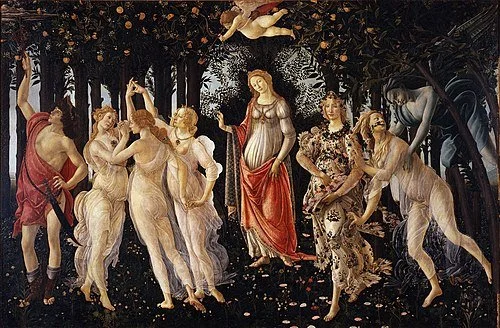
Primavera by Sandro Botticelli
The figure in the middle of the painting is not the Virgin Mary, but the goddess Venus (surprise!). During the Renaissance, the influence of classical Greek and Roman culture let to a revival of ancient Platonic philosophy, which saw everything emanating from “the one”. Renaissance thinkers saw a clear link between “the one” and their own Christian god and started to explore the relationship between mythology and Christianity as different representations of similar universal truths and values. If everything was emanated from the same source, everything was connected and could have meaning in it, even pagan myths, as they are simply allegorical expression human values and characteristics.
Venus was thus the ancient equivalent of the Virgin Mary, representing divine love as her son Cupid flies above her, but now covered in modest clothing with a serene expression crossing her face. Next to her stands right are the Three Graces, who represent chastity, beauty, and love. They’re intertwined as sisters in what appears like a dance, gazing at each other with transparent gowns. The god Mercury is at the far left of the painting while the west wind Zephyrs kidnaps the nymph Chloris to marry her, dragging her into the woods. Chloris falls in love with her captor, transforming into Flora, the goddess of flowers.
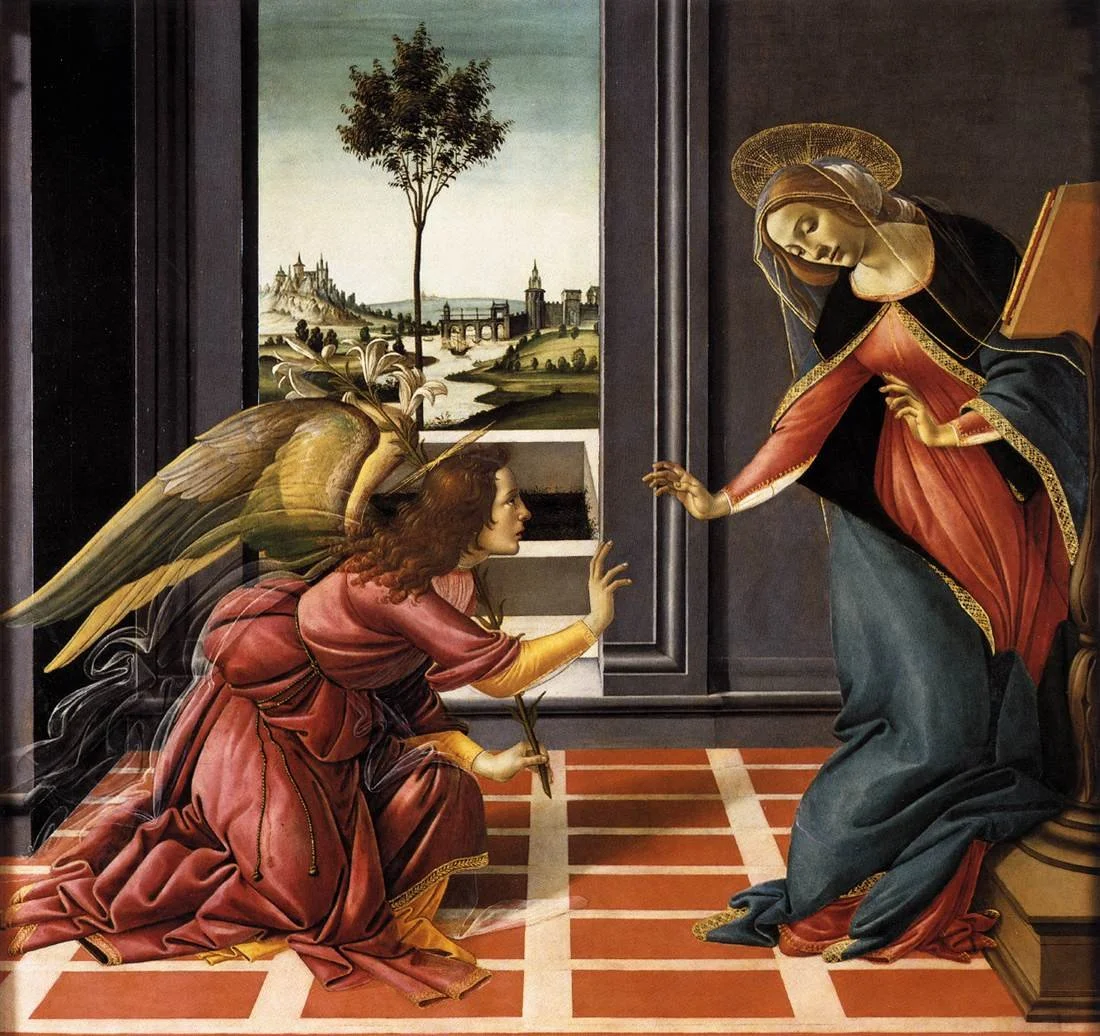
The Annunciation by Botticelli
Long after 10th grade English Lit, when I discovered that this painting was a depiction of spring, my first reaction was one of surprise. It makes sense when you look at the over 130 species of flowers represented in the painting and the fact that Venus, the goddess associated with April, presides off center in the painting next to Flora, but this was not my interception of Botticelli’s masterpiece before I studied its meaning.
Primavera is not the typical depiction of spring in which we see fields of green meadows and the shining light of the sun. The use of dark colors within the background is adamant. The trees and ground on which the classical figures stand on are various shades of black. The sun has almost set on the scene, capturing the small amount of time in between daylight and nighttime. The brightness and use of color is concentrated on the figures, while Zephyrs threatens to bring this lightness back into the dark. Stylistically, Botticelli appears to be representing spring’s equality between day and night.
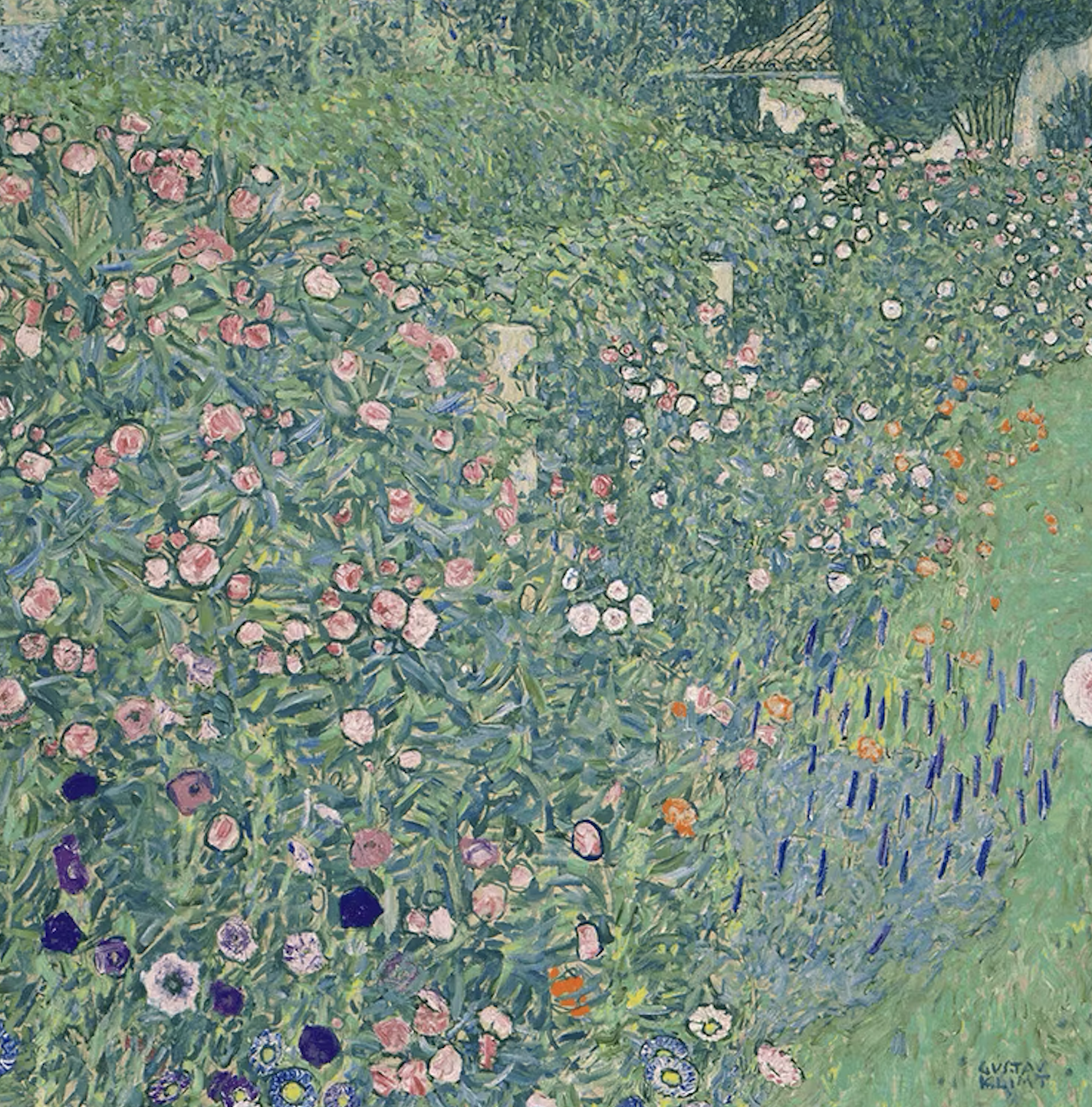
Garden landscape by Gustav Klimt
The feeling I was left with was not a feeling of the warmth I associated with spring, but of having stepped into these dark and eerie woods, unsure if I would be absorbed into them or taken by Zephyrus. I felt like a participant within a fairytale where the ending has not yet been decided.
Walking within Primavera reminded me of this mental image I’ve been able to picture and feel for the past 6 months or so. In this image, it feels like I have walked through the dark woods and am at the edge of a cliff. Peering over, all I see immediately is fog, but beyond it I can see a vision of what could be. I take a step back. And another. Until I find myself at the edge of the woods once more. I fall asleep and am lulled by the orange blossoms, but it’s a trance. I’ve been taken back into some sort of limbo, not quite back where I was but not quite where I’m supposed to be yet.
It conjures up one of the set designs in the movie Hamnet, which if you haven’t seen, you should watch immediately. The woods are similar to Botticelli’s painting, just without the oranges, and Hamnet, Shakespeare’s young son who has died is lost inside these woods and can’t get out. He can’t leave until his parents have fully grieved him is he fully released.
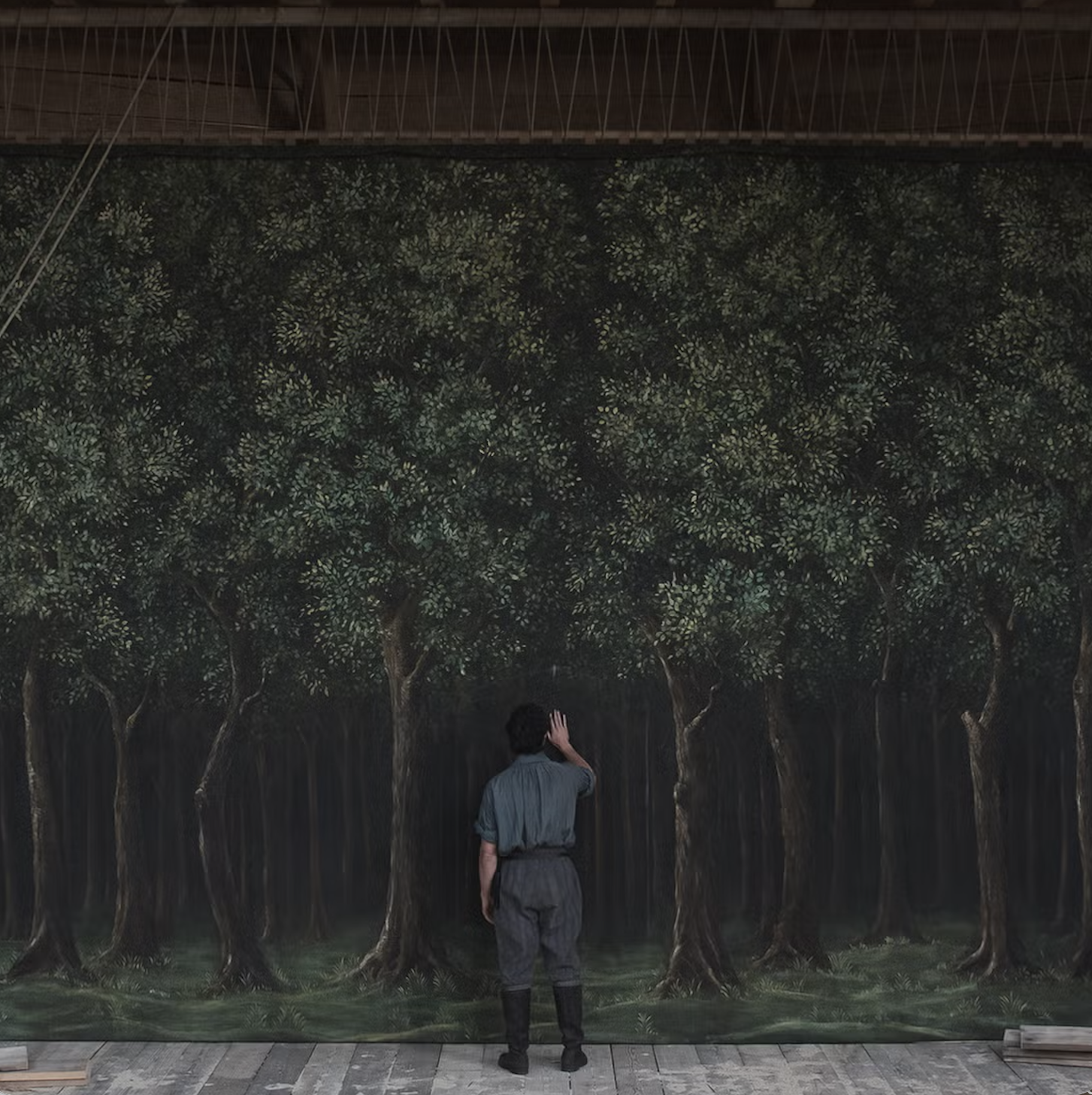
The woods from Hamnet
But I guess that’s the point, isn’t it? We can’t fully leave the dark woods, the limbo, until it is time. We cannot leave, as much as we want to, until certain things are finished, until certain feelings are fully processed or we step beyond our previous awareness. Spring is not summer. Birth, beginnings, and transformation have their own timeline to which you can nourish the seed, but you cannot make it bloom before it’s ready to.
Spring is the threshold and limbo period where night and day, darkness and lightness, have become equal in measure. The imbalance of winter that favors darkness has passed and rebirth and transformation is being ushered forward, but we are still in a period of transition that doesn’t bias the brightness of day.
We are no longer deep inside the woods, but they still loom in the background. The women are still pregnant and the baby has not yet been born. Zephyrus still threatens to pull us back for more lessons while Mercury eagerly attempts to block the winds of winter. We haven’t yet reached summer but we are on our way out of the woods.
With love,
Zoë
