Letters, Summer 1926
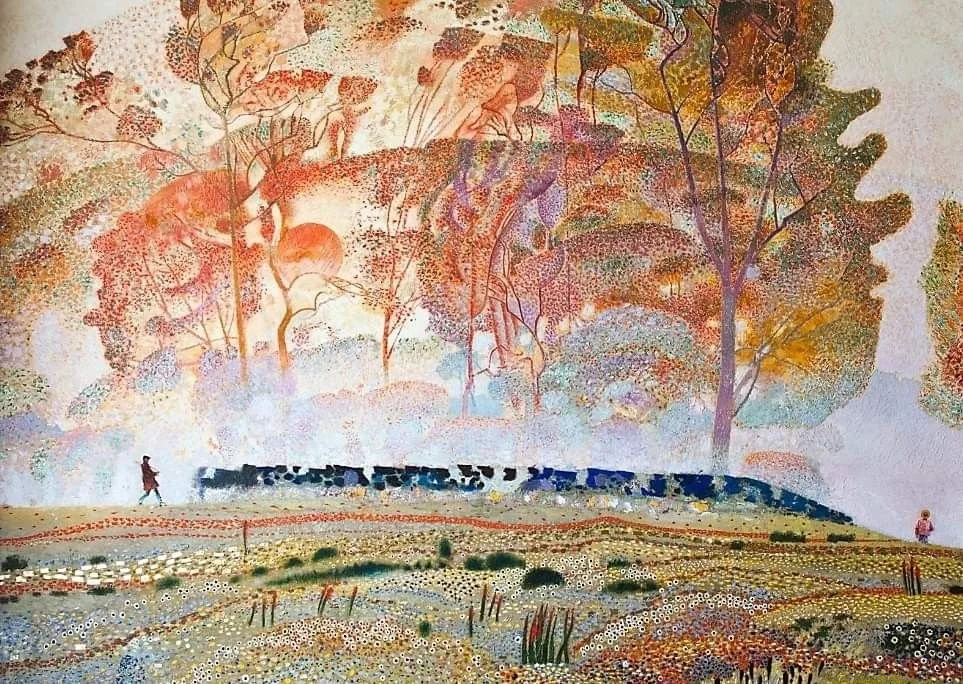
Glowing Sky by Viktor Zaretsky
I almost contemplated titling this musing a Romantic Three-way, for I’ve been reading this book, Letters, Summer 1926, that is a series of three-way love letters. But I didn’t want to give the wrong idea. Venus et La Lune is not that kind of blog. The notable Susan Sontag actually wrote the preface, which was the easiest part to get through, for the book is one big conglomerate of translated correspondence between three poets that traversed across Europe during the summer of 1926. Either way, it makes me yearn to go back to the age of writing letters.
The three poets in question are Rainer Maria Rilke, an Austrian poet, and his Russian disciples Boris Pasternak and Marina Tsvetaeva. Rainer Maria Rilke is well known for his books Letters to a Young Poet and Sonnets to Orpheus. When I started this book, that synchronous thing happened where I started to notice Rilke’s name popping up everywhere. One of my favorite podcasts, On Being, has several great episodes about him and his transformative work if you’re interested in learning more. I’d also heard of Pasternak, who’s most well-known for writing Doctor Zhivago, which I just started reading after going down a Russian rabbit hole.
Marina Tsvetaeva is perhaps my favorite of them all. The only woman of the group, Tsvetaeva has a disruptive style of syntax that jumps around with her thought process, intertwining myth and folklore, a deep reverence for nature, and a dramatic but endearing interpretation of everyday life. Her style is so unique that it’s difficult to translate her work into different languages while retaining the original meaning, making her somewhat of an unexplored mystery outside of Russia.
Tsvetaeva unapologetically lives in another world. Where her physical reality was defined by sparseness, heartbreak, and the myriad of trauma and difficulties that accompanied the Russian Revolution, two subsequent world wars, and life in the Soviet Union, her inner-world and spirit remained separate and was one of romantic excess and eroticism. She was in active player in life who felt things deeply, deeper perhaps then they sometimes needed to be felt in order to carry on, but life was a dance that provided constant inspiration for her writing.
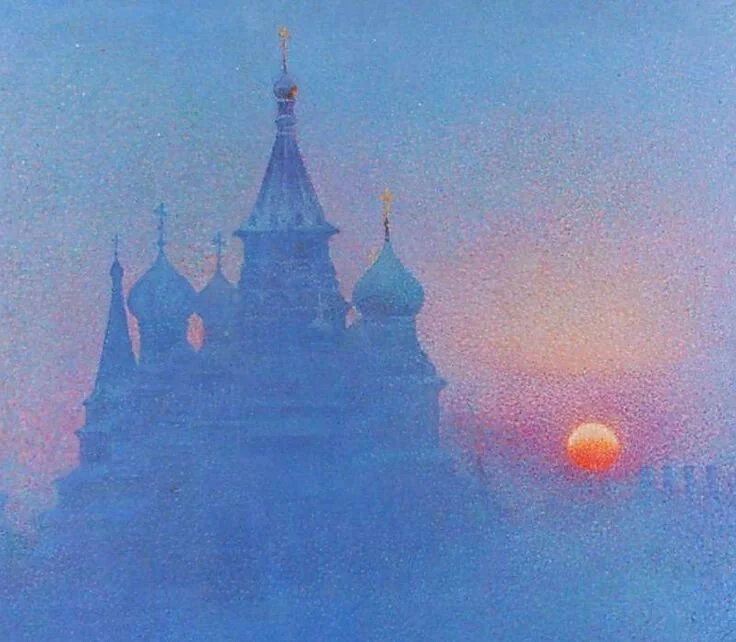
St. Basil’s Cathedral by Krylov Vladimir
You can see this romantic excess throughout many of the letters in the book. Rilke is perhaps the most rational and is indeed put off by the intensity of his two followers. Tsvetaeva and Pasternak appear as two tormented souls, in love with the phantoms of each other they have created in their own minds. They are absurd and incoherent at times, projecting each others’ obsessions. The exaggeration in the correspondence is somewhat comical at times, but it makes for beautiful writing and encompasses their view of the world.
I found myself relating to the three poets who found themselves living in a ‘world of the body’ and not of the ‘spirit’, disconnected from God and nature. They believed that a true and worthy existence was inherently spiritual and that the artist and the poet were avenues in which the divine spoke. The artist, the individual, and the work were separate and the creation itself developed a life of its own. In one letter to Tsvetaeva, Pasternak describes this duty of the artist.
“The main thing is what you are engaged in. The main thing is that you are building a world crowded by the mystery of genius. In your time, in your life, this crown, this dome, merges with the sky, the live blue sky above the city where you live, or which you see in your imagination as you ply your alchemy. At another time other people will walk beneath it and the world will see other epochs. The soil of the cities is roofed over by the mysterious genius of other centuries.”
Beyond the sheer beauty of the writing, what attracted me to this book it is the idea that art and creative expression is the physical manifestation of the divine in the temporal world. Beauty, whether that be in nature, a verse, or a song, is not an accident and something greater than the individual is being spoken in a true piece of art. It becomes a portal that outlives itself and that transports people to another reality, another way of being that is maybe closer to the core of it all.
I haven’t finished the book yet. I think it will take me exactly as long as the correspondence themselves lasted (3 months). But in this sprit of portals and divine expression, I wanted to leave you with a few of my favorite quotes I’ve gathered in the book so far that are providing some inspiration at the start of my week. It appears I haven’t highlighted anything from Rilke …
“I can’t understand you. Stop writing poetry? And then what? Jump off the bridge into the Moscow River? with poetry, dear friend, as with love: no separation until it drops you. You are the lyre’s thrall.” (Marina Tsvetaeva)
“Don’t fret that the apparent impossibility of something is the first sign of its naturalness—in a different world, obviously.” (Marina Tsvetaeva)
“One forgets that the only thing within our power is the ability to keep the voice of truth within us undistorted. The inability to find and speak the turret is a failing that no talent for speaking the untruth can disguise.” (Boris Pasternak)
“I was a fool to hope I could see your sea with my eyes — that which is beyond eyes, above eyes, within eyes.” (Boris Pasternak)
“I will not deprecate myself; that will not make you greater (or me lesser), it will only make you more lonely, for on the island where all of us were born, all are like us.” (Boris Pasternak)
With Love,
Zoë
