Portraits
I have always had an obsession with the ‘old’. People, places, art, antiques. I was fortunate enough to spend a lot of time with my grandparents as a little girl, and I think they rubbed off on me in all the best ways.
I go to a weekly group on Thursdays and was talking last night about how often times I feel more comfortable with those decades older than me than I do with people my own age. The years that separate us dissolve any barrier of competition, that habit we learn at a very young age to measure ourselves as either superior or inferior to those next to make sense of a very confusing world.
When I was little, I was also always fascinated by my grandparents’ stories, the stark contrasts but also similarities I could make to my own life. Stories allow one to be transported into a different life, but a life that’s not out of the realm of imagination because it’s clear that human experiences remain relatively predictable. The set is constantly changing, characters enter on stage right and exit stage left, learning the script and the plot along the way. Despite whatever time period you’re born in, this is the basic framework: We’re born, we cry, we laugh, we love, we hate, and we die. The next person that enters the stage does the whole thing all over again.
What also attracted me to these stories is that as someone who wanted to plan and predict the future, I could see all the multitude of possibilities for one life, all the different versions and pivots, laid out in front of me. I felt like I could add to my experience by sort of taking from theirs. I could, on a visceral level, place myself back in their time. I could feel myself and the space described, picture my surroundings and hear the voices. It wasn’t just a story, but a portal to a collective human experience that might as well could’ve been mine if I had been born in a different time and under different circumstances.
Enticed by people, things, and stories older than myself, my favorite literature genre has naturally been historical fiction since I discovered it in 3rd grade. The most recent historical fiction book I about a month ago was the Marriage Portrait by Maggie O’Farrel. If she sounds familiar, it’s because she’s the author of Hamnet, which was just adapted into one of the most beautiful films I’ve seen in a long time.
The Marriage Portrait wasn’t quite as poetic in my option but it did have a few passages that spoke to me. Near the end of the novel, the protagonist Lucrezia, a 16th century duchess who’s found herself married to a monster and believes she’s about die, looks at her recently finished marriage portrait and thinks.
“Across the room, propped against the wall, is herself- another self, a former self. A self who, when she is dead and buried in her tomb, will endure, will outlive her, who will always be smiling from the wall, one hand poised to begin a painting.”
While most of us will never have our portraits painted, we still have these different portraits of ourselves, not hung on a wall for everyone to see for eternity, but on shelves in our mind. These many former selves are also captured at different times during our lives. Some of them we loathe, we don’t like the brush stroke, the way our hair looked, the marks on our face we got during puberty. Some we feel fond towards, we like how the artist painted our baby smile, the full rosy cheeks, and reflected the innocence in our eyes. A few special ones, versions that either our parents liked or we had a particular fondness for maybe made the cut to be printed and will outlive us for a while.
As the subject of the portrait, we can be cruel and unforgiving, we’d really rather forget some of these versions captured in time and have them stored or thrown away, but I think about how we would look at these versions of ourselves differently, the various versions captured in photos that we frown at, if they were portraits hung up in a gallery, all that was left of us when everything else that knew us is gone.
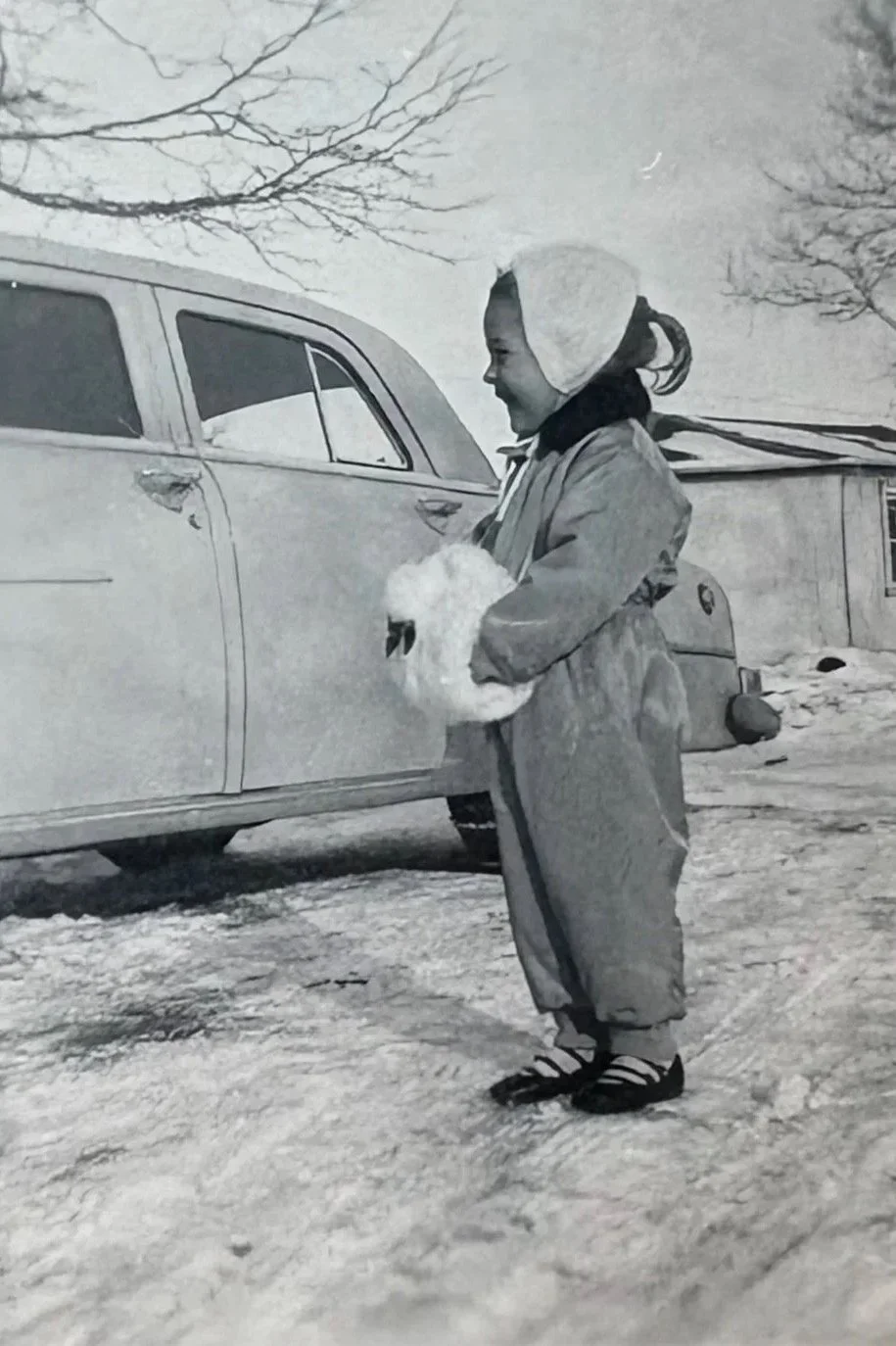
As I write this, I have a sort of ‘portrait’ of my grandmother as a little girl in 1950 hanging on my bulletin board. It’s not a painted portrait, but a pre-digital photo that captures a similar magic. Since film and printing still cost money, people were more selective about their portraits and various versions they chose to capture. The photo was still something you viewed in your hands and could touch and smell. Until photography was completely digitized, its incapability of completely capturing visual reality in full color or clarity also still allowed room for the imagination to wander about the subject at hand.
In this old photo, my maternal grandmother is standing next to an old car in the snow, in side profile, wearing a little snowsuit with her hands wrapped in a muff and her ears covered with matching fur. I can’t see her entire face, but I can see the delightful joy of a little girl around 4 years old.
In my bathroom there’s another photo probably taken around the same time but hundreds of miles of my paternal grandmother. She’s in her late 20’s wearing a silk dress and cropped silk jacket, her arms behind her head pinning her hair back, smiling at the camera as she’s about to get married for the second time.
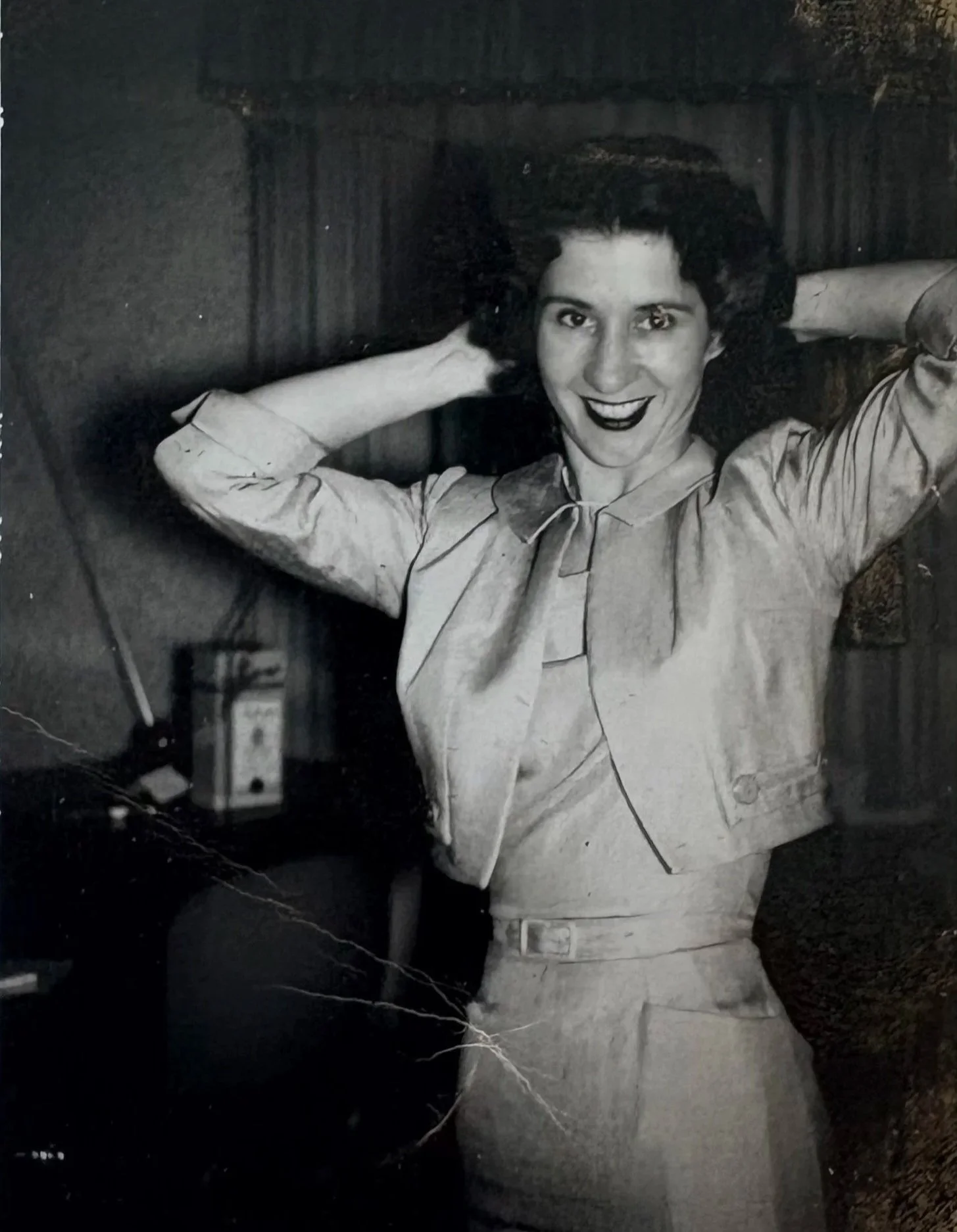
These old photos of my grandmothers I have are the closest thing I will ever have to painted portraits of former versions of them I never got to meet. What’s interesting is that when I look at these photos, it feels like I know this part of them because it also as if I’m looking at a version of myself captured in another time, in another life.
I can see myself in the photo of Bigmama in my bathroom when I’m getting ready, the way I look at the mirror in a similar way the woman in the photo looks a the camera. I can see her in me briefly when I clip my hair back. Through the door and across the room the little girl standing next to a car may as well be me. We looked like twins at that age. In fact Nina used to have another picture of herself around that same age displayed in her house and I asked her one day “Nina, when did you take that picture of me? When was that?”. In neither of these photos was I ever there, but just like how I used to be able to place myself in their stories, I’m also able to place myself in their portraits in a similar way.
Seeing certain features and a physical resemblance in these photos is obviously not out of the realm of possibility. To see your eyes, hair, or smile in a photo of a relative is simply science and the way the X and Y chromosomes chose to express themselves. What I feel is different though. It’s not just similar physical features that I see in these photos. I can see and feel myself in that moment in some strange way.
Somehow, and against rational logic, I feel connected to my grandmothers and all the women and generations that came before me that extends beyond genetics. I believe there’s an underlying thread weaving us all together as portraits go on and off the walls and genetics get more mixed up. I can see it and feel it in these photos. I can feel their collective wisdom, their joy, sadness, fear, hopes, and pain. The women I will never know the names of, who’s stories have disappeared with their bodies like they were never here. But they were here, and on a strange level I, or my soul, feels a direct tie to them. I’m just one part of a tapestry that not yet finished. When I’m scared or alone, if I really dig deep, I can feel these women behind me.
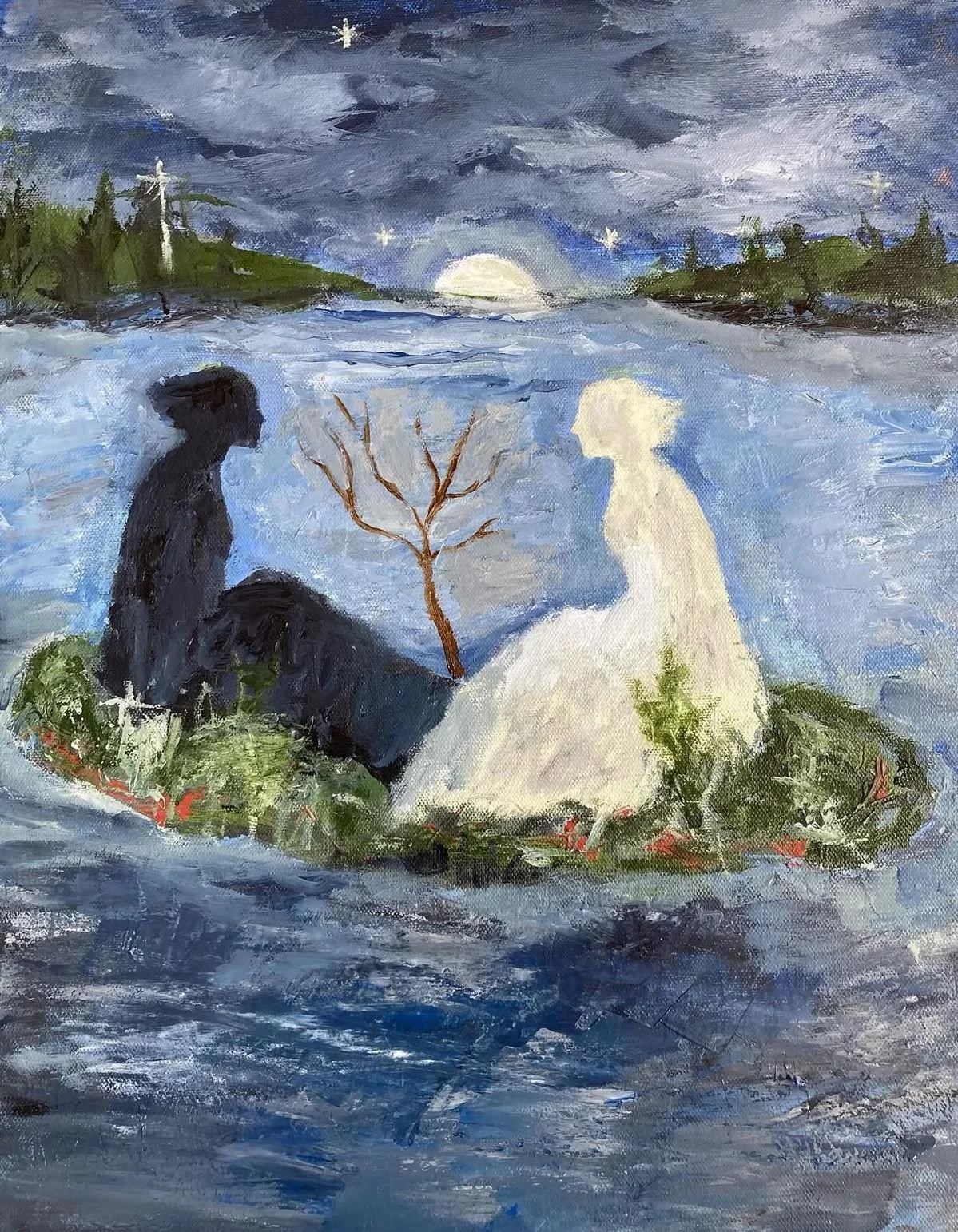
Maybe I like the old, the stories and the portraits and the decaying antiques, because here lies the tangible evidence of the ongoing thread throughout the tapestry, that I’m still tethered to knowledge and supported by people I never met or have long since passed.
But if it were all gone, if all the all the stories, portrait paintings, and photos, all the former selves of these ancestors would remain. They would exist in versions of yourself you take on and off of the shelves in your mind. They would be present in a smile or a laugh or how you roll your eyes when you’re upset. And maybe when you catch a glimpse of yourself in the review mirror, someone now gone, a grandmother or great-grandmother, is there in the way you tilt your head.
xo Zoë
